There are several types of pruning, but here we will focus only on some basic principles. In essence, pruning means balancing the ratio between the root system and the canopy and creating ideal conditions for producing high-quality fruit.
With proper pruning we:
a) keep the olive tree “young” and healthy
b) improve light penetration into the canopy, which increases photosynthesis and improves fruit quality
c) reduce the risk of fungal diseases (peacock spot, sooty mold)
d) control the growth of the tree
e) ensure pruning is fast, efficient and adapted to the variety
f) carry out pruning every year
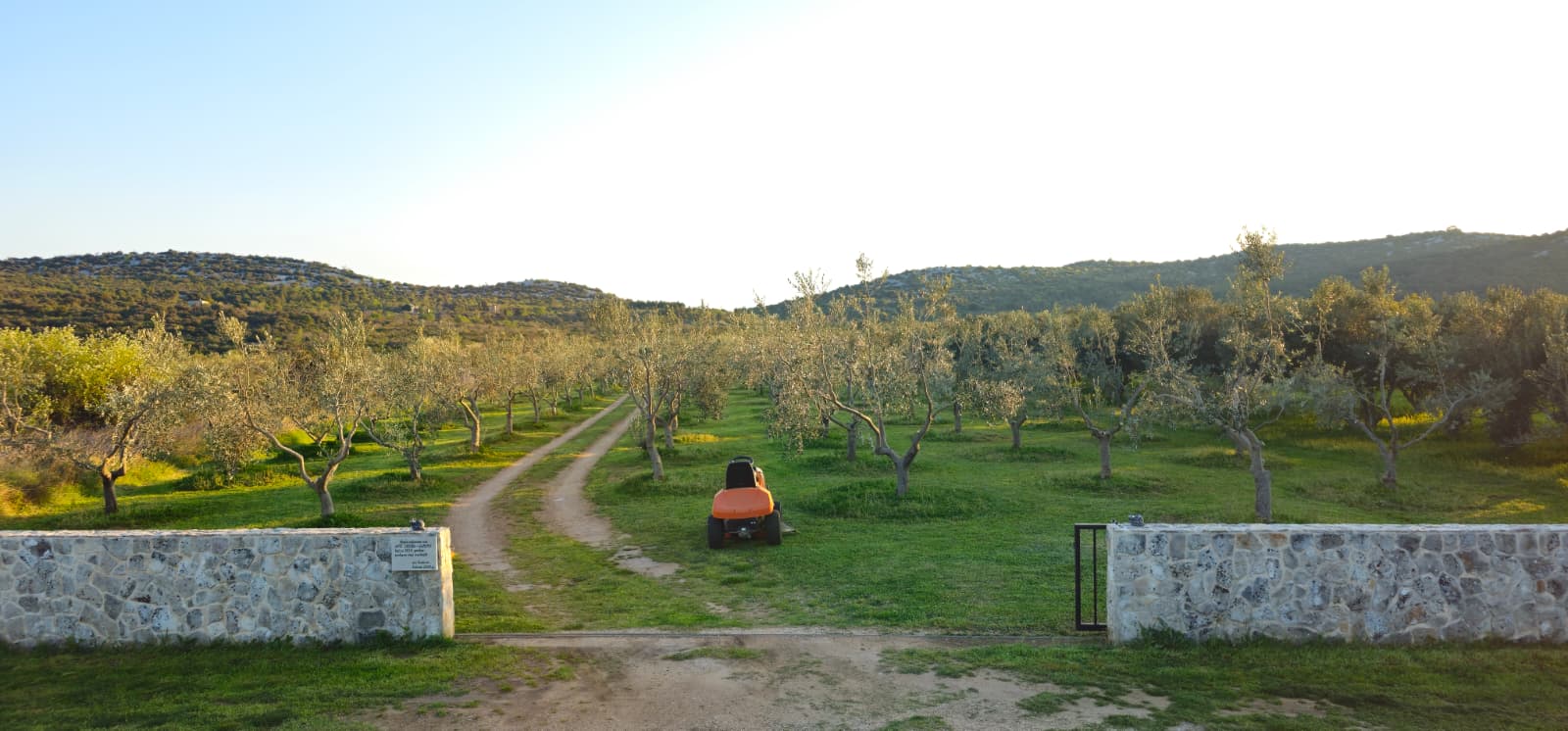
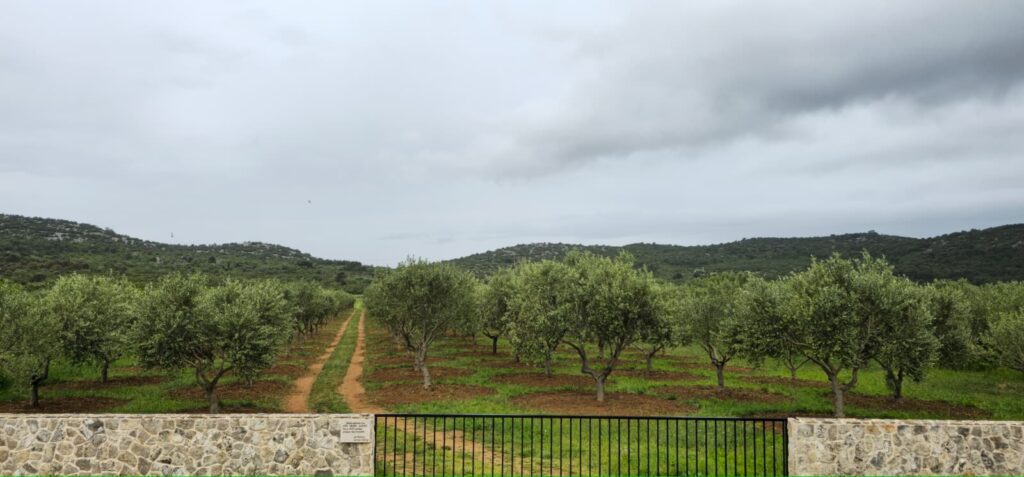
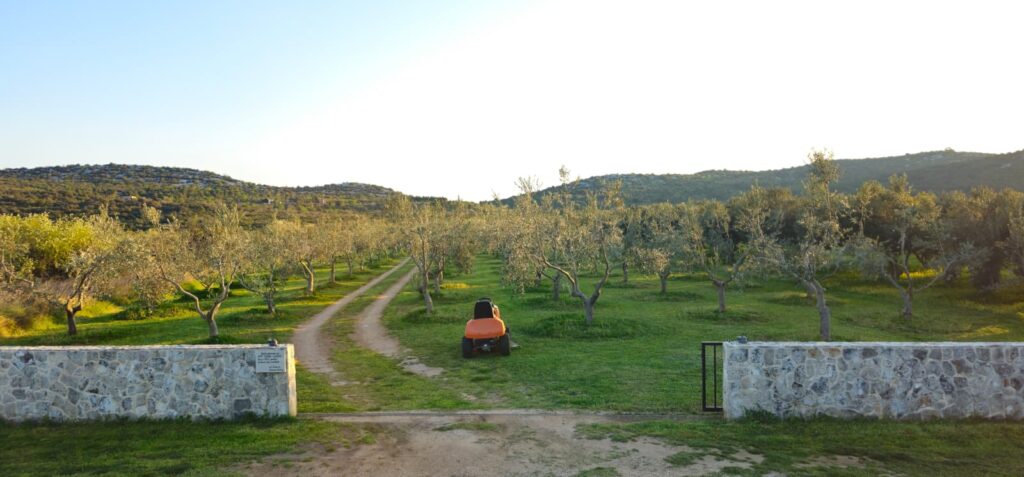
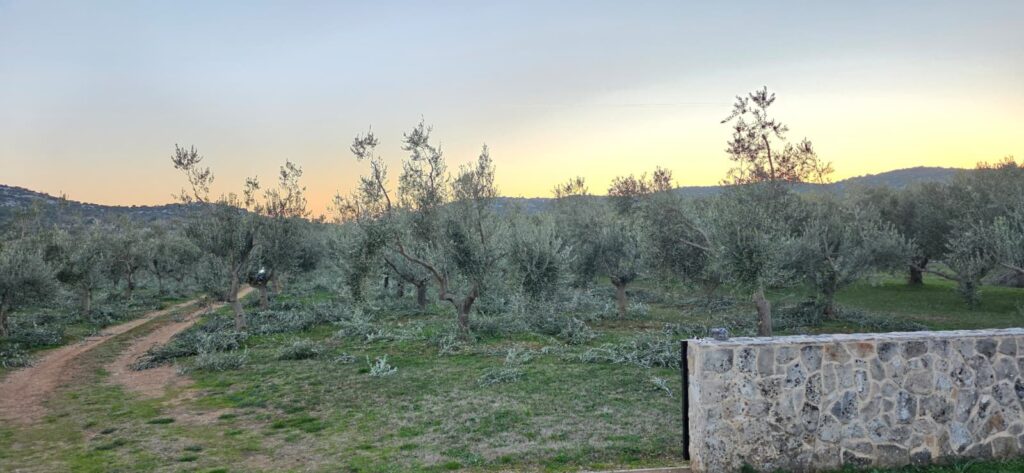
The first photo shows the olive grove before pruning, the second immediately after pruning, and the third one year later. Pruning is demonstrated using the polyconic vase training system (multi-cone system).
a) Proper pruning means recognising fruit-bearing branches and removing old, exhausted and damaged wood. This process encourages the tree to produce new shoots, which will become future fruit-bearing branches. If a tree has too much woody mass and too little leaf mass, it ages faster and loses productivity.
b) Photosynthesis is the basic process in every plant. It enables the tree to produce food, develop leaves and form oil. The oil in the fruit is formed from sugars produced during photosynthesis. Proper pruning ensures even light distribution throughout the canopy, so sunlight reaches all branches as equally as possible.
c) By thinning the canopy, we reduce moisture inside the tree and allow sunlight to help prevent fungal diseases. With correct pruning, the use of plant protection products can be reduced by up to 70%.
d) Since most of our growing areas are limited in space, every square meter is important. Pruning allows us to guide the tree where we want it to grow and control its height. It is important to cut the tree only to a height that can be reached with the tools we have. Today, there are tools that allow pruning at several meters in height, as well as harvest shakers that make it possible to reach heights of 4–5 meters.
e) Pruning is the most time-consuming and the most expensive agricultural practice. For that reason, it must be carried out efficiently and without spending too much time on each tree. Some varieties require more specific pruning due to their growth habit. Varieties with drooping branches are pruned more heavily in the lower part of the canopy to lift it upwards. Varieties with strong vertical growth are limited in height and guided to grow wider.
f) All these processes must be repeated every year. When we return to the same tree each year, we learn more about it and can take its characteristics into account the following season. Regular pruning allows faster and more efficient work because the canopy does not become overcrowded and old branches do not require drastic cuts.
Pruning can be light (up to 20% of leaf mass removed), moderate (around 30% removed) or heavy (more than 50% of leaf mass removed).
From 7 to 28 March 2026, the Days of Olive Oils of the Hinterland of Šibenik-Knin County will take place. On the very first Saturday, 7 March, a pruning course on the polyconic vase training system (also known as the multi-cone form) will be held.
All event details are available at the following link: https://ultraextra.hr/en/days-of-olive-oils-of-sibenik-knin-county-hinterland/